

I still remember the morning it happened. It was a cold Tuesday. I had just bought a fresh bag of whole beans the night before. I walked into my kitchen, half-awake, reached for my grinder — and nothing. The motor had died overnight. No warning. No second chances. Just a sad, silent machine and a bag of whole beans staring back at me.
I had two choices. Give up and go back to bed. Or figure out how to grind coffee beans without a coffee grinder.
I chose chaos. And honestly? It worked out better than I expected.
If you’ve ever been in that same spot, this guide is for you. I’ve tried almost every method out there. Some were great. Some were a mess. I’ll tell you exactly what happened and what you should do.
Table of Contents
Why the Grind Size Actually Matters
Before I started experimenting, I didn’t think grind size was a big deal. I thought coffee was just coffee. I was wrong.
<<Get Amazon For This Product>>
The grind size controls how fast water pulls flavor from the bean. A fine grind means more surface area. More surface area means faster extraction. Go too fine for the wrong brew method and you get a bitter, harsh cup. Go too coarse and your coffee tastes weak and watery.
Here’s a quick look at what grind size works for which method:
| Brew Method | Grind Size Needed | Why It Matters |
| French Press | Coarse | Prevents muddy, over-extracted coffee |
| Drip Coffee Maker | Medium | Balanced flow and extraction |
| Pour Over | Medium-Fine | Clean and bright flavor |
| Espresso Machine | Fine | High pressure needs resistance |
| Cold Brew | Extra Coarse | Long steep time, slow extraction |
| Turkish Coffee | Extra Fine | Boiled directly, needs full dissolve |
Once I understood this, I knew which kitchen tools to reach for. The goal wasn’t perfection. It was getting close enough to enjoy a decent cup.
How to Grind Coffee Beans Without a Coffee Grinder: 6 Methods I Tested
Using a Blender
This was my first instinct on that awful Tuesday morning. I had a standard countertop blender and figured — why not?
The key is to use the pulse setting, not a continuous blend. I put in about a quarter cup of beans and pulsed for two to three seconds at a time. Then I shook the blender. Then pulsed again. I kept going until I got a medium-coarse grind.
The result? Honestly pretty good. The grind was a little uneven, but my drip machine didn’t care. The coffee came out warm, rich, and exactly what I needed that morning.
One thing to watch: don’t run the blender too long. The heat from the motor can warm up the beans and mess with the flavor. Short bursts are your best friend here.
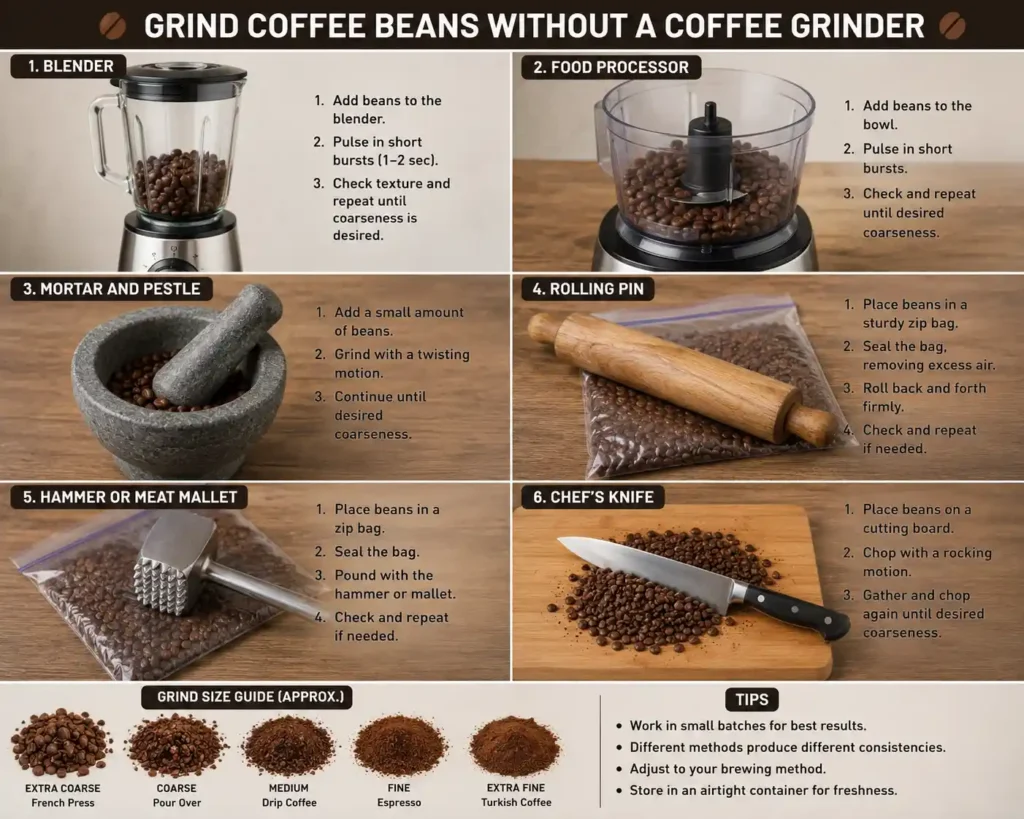
Using a Food Processor
A few weeks later I tried the food processor just to compare. It works on the same principle as a blender — pulse, shake, pulse. But the wider bowl means the beans bounce around more. This makes the grind less consistent.
I used it for cold brew that weekend and it was totally fine. Cold brew is forgiving. A coarse, slightly uneven grind still gives you a smooth, mellow result after a 12-hour steep in the fridge.
If you’re making espresso or pour over, skip the food processor. It won’t give you the precision you need.
Using a Mortar and Pestle
I’ll be honest. I underestimated how long this takes. I borrowed my neighbor’s mortar and pestle one Sunday and decided to grind enough beans for two cups.
It took me about eight minutes. My wrist was tired. But the grind? It was the most consistent of any method I tried. I had real control. I could press harder for a finer grind or ease up for something coarser.
If you want to make Turkish coffee or a strong espresso-style brew and you have the patience, this is the method for you. The texture is almost silky-fine if you work at it long enough.
My tip: press and twist, don’t just pound. Pounding sends beans flying everywhere. I learned this the hard way when I launched a bean across the kitchen and hit the cat.
Using a Rolling Pin
This one surprised me. I didn’t expect much, but it actually works really well for a quick coarse grind.
I put the beans in a zip-lock bag, squeezed the air out, and sealed it. Then I used the rolling pin to press down firmly and roll back and forth. The first pass cracks the beans open. After that, you roll with more pressure to break them down further.
The grind is rough and chunky. It’s perfect for the French press. It took me about three to four minutes for a single serving.
One honest note: the bag can split if you press too hard. Use a double bag or a thick freezer bag to avoid a messy counter situation.
Using a Hammer or Meat Mallet
I tried this method mostly out of curiosity. And yes, it’s exactly what it sounds like. Beans go in a sealed bag, and you whack them.
I used the flat side of a meat mallet. Flat side matters — the textured side shreds the bag and makes a mess. I tapped firmly rather than going full force.
The result was very uneven. Some pieces were almost powdered. Others were barely cracked. I used it for cold brew where the inconsistency didn’t matter much. But I wouldn’t recommend this for anything that needs a precise grind.
It’s also kind of loud. My roommate was not thrilled at 7 AM.
Using a Chef’s Knife
This method is slower than the others, but it gives you decent control. I laid my beans on a cutting board and used the flat side of a wide chef’s knife to press down and crack them. Then I rocked the blade over them like I was mincing garlic.
It’s a good medium grind. Not as fine as a mortar and pestle, not as coarse as the rolling pin. I used it for a pour over once and it came out better than I expected.
The key is patience. Don’t rush. Keep chopping and checking the texture as you go.
A Quick Comparison of All 6 Methods
Here’s what I found after trying everything:
| Method | Time Needed | Grind Consistency | Best Brew Method |
| Blender | 2–3 minutes | Medium | Drip, French Press |
| Food Processor | 3–4 minutes | Low | French Press, Cold Brew |
| Mortar and Pestle | 7–10 minutes | High | Espresso, Turkish |
| Rolling Pin | 3–5 minutes | Medium-Low | French Press |
| Hammer or Mallet | 2–3 minutes | Low | Cold Brew |
| Chef’s Knife | 5–7 minutes | Medium | Pour Over, Drip |
Tips That Made a Real Difference
After all my trials and errors, a few small habits made my coffee come out much better.
Freeze your beans for ten to fifteen minutes before grinding. Cold beans crack more cleanly. They don’t gum up the blender or stick together as much. I started doing this after a batch came out chalky and dull, and the difference was clear.
Grind in small amounts. A quarter cup at a time gives you more control and a more even result. Bigger batches just lead to a chaotic mess.
Grind right before you brew. Coffee starts losing its freshness within minutes of being ground. The oils in the bean oxidize fast. If you grind and then wait, the cup suffers.
For French press and cold brew, don’t stress too much. These methods are very forgiving. An uneven, chunky grind still produces great coffee. They were made for this.
What I Learned From All of This
That dead grinder turned out to be a weirdly good experience. I learned that knowing how to grind coffee beans without a coffee grinder is a genuinely useful skill. You don’t need fancy equipment to make a solid cup of coffee.
The blender is your best everyday option if you need speed and decent results. The mortar and pestle is your best option if you want control and quality. The rolling pin and knife are great middle-ground choices when you have a little time.
None of these methods will replace a proper burr grinder. But in a pinch — on a cold Tuesday morning when your grinder dies — they absolutely get the job done.
And honestly, there’s something satisfying about making it work with what you have.
FAQ: How to Grind Coffee Beans Without a Coffee Grinder?
Q1: Can I really grind coffee beans without a coffee grinder?
Yes, you can. Common kitchen tools like a blender, rolling pin, or mortar and pestle all work well. The grind won’t be perfect, but it’s more than good enough for a solid cup.
Q2: Which kitchen tool gives the most consistent grind without a grinder?
A mortar and pestle gives you the most control. You press and twist the beans to get a fine, even texture. It takes about eight minutes, but the result beats every other manual method.
Q3: Is a blender safe to use for grinding coffee beans?
Yes, a blender is safe and works great. Just use the pulse setting in two to three second bursts. Running it too long heats the beans and hurts the flavor, so keep it short and shake between pulses.
Q4: What is the fastest way to grind coffee beans without a grinder?
A blender or hammer method takes just two to three minutes. Both give a rough, uneven grind. They work best for French press or cold brew where grind consistency matters less.
Q5: Does freezing coffee beans before grinding without a grinder actually help?
Yes, it does. Cold beans crack more cleanly and don’t clump together in a blender or bag. Freeze them for ten to fifteen minutes before you start and you’ll get a noticeably better grind.