

I still remember the night this question hit me. I was standing in my kitchen in Austin, filling my Pur pitcher after a long shift at work. My neighbor had just told me her dentist warned her about too much fluoride in tap water. I looked down at my pitcher and thought, wait, does this thing even take fluoride out? I had no idea. So I did what any curious person does. I started digging, testing, and asking questions. This article shares everything I found, in plain simple terms.
Table of Contents
Why I Started Asking If My Pur Filter Removes Fluoride
For years I trusted my Pur pitcher without a second thought. I filled it, waited a few minutes, and drank the water straight from the fridge. It tasted clean. It smelled fine. I assumed clean meant everything was gone, fluoride included.
That night with my neighbor changed things. I started reading labels on the box. I called Pur customer support one afternoon while making dinner. I even texted my dentist, who is also a family friend, to ask if my filter was doing anything about fluoride at all. Every answer pointed the same direction, and it was not the one I expected.
<<Get Amazon For This Product>>
I will admit I felt a little silly at first. I had owned this pitcher for almost two years and never once checked what it was actually built to do. I think a lot of people fall into that same habit. We buy a filter, see clear water come out, and assume the job is done. That assumption is exactly what pushed me to dig deeper and share what I found with you here.
How A Pur Water Filter Actually Works
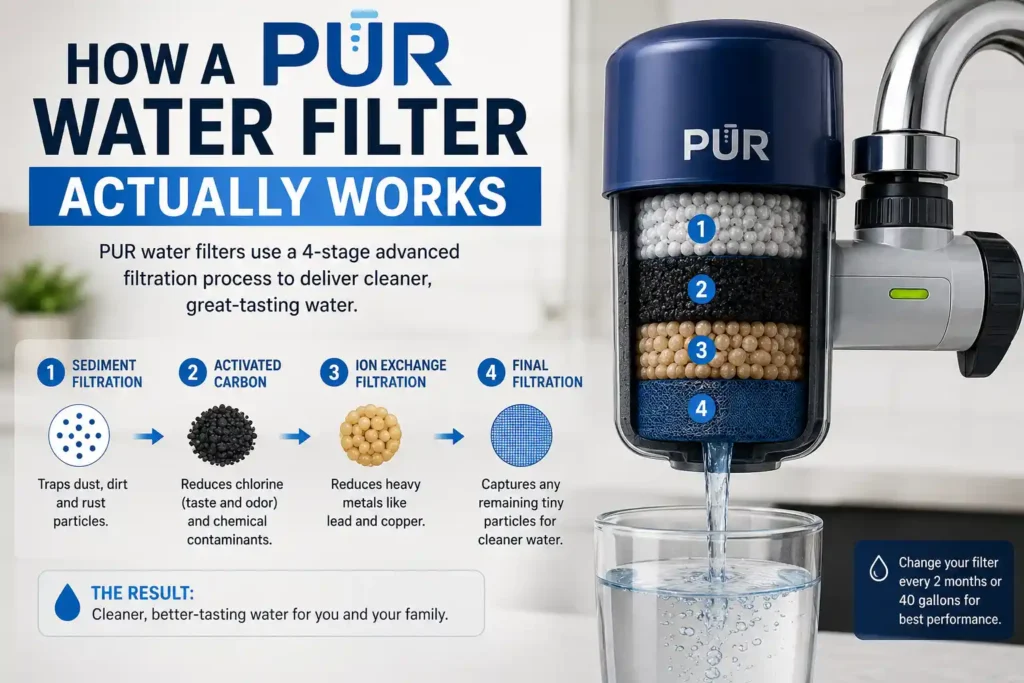
Before we get to fluoride, it helps to know what is happening inside that little cartridge. A Pur filter uses something called activated carbon. Think of it like a sponge covered in millions of tiny holes. Water passes through, and the carbon grabs onto certain particles as they pass by.
The Carbon Block Inside Every Pur Filter
The carbon block is great at trapping chlorine taste, certain heavy metals like lead and mercury, and some industrial chemicals. I noticed this myself. My water tasted less like a swimming pool after I started using it daily. But carbon has limits. Fluoride is a tiny charged particle, and plain carbon simply is not built to catch it.
I like to picture it this way. Imagine trying to catch confetti with a fishing net. The net works great for tennis balls, but tiny confetti pieces just slide right through the gaps. Fluoride behaves a lot like that confetti when it meets a carbon filter. The pores are simply the wrong shape and charge to hold onto something that small.
Does The Pur Water Filter Remove Fluoride
Here is the direct answer. No, standard Pur pitcher and faucet filters do not remove fluoride. Pur has never claimed to reduce fluoride, and their filters are not certified by NSF or WQA for fluoride reduction. I confirmed this with their support team myself, and their answer was calm and clear. Fluoride simply passes right through.
An independent lab test on a Pur Plus pitcher backs this up with real numbers. The table below shows what that testing found for common contaminants in tap water.
| Contaminant | Reduction By Pur Filter |
| Uranium | About 80 percent |
| Copper | About 98 percent |
| Nitrate | About 42 percent |
| Strontium | About 100 percent |
| Barium | About 4 percent |
| Molybdenum | About 23 percent |
| Sulfate | About 4 percent |
| Fluoride | 0 percent |
Seeing fluoride sit at zero was honestly a bit of a surprise the first time I read it. My pitcher was working hard on almost everything else, yet fluoride walked right through like the filter was not even there.
Why Fluoride Slips Past Pur Filters
This comes down to chemistry, not a flaw in the product. Fluoride ions are small and carry a negative charge. Activated carbon is built to trap larger organic molecules and certain metals through physical trapping and light chemical attraction. Fluoride does not stick to carbon the same way lead or chlorine does.
To catch fluoride, a filter needs a different kind of media. Options include activated alumina, bone char, ion exchange resin, or a reverse osmosis membrane. None of these are part of a standard Pur cartridge. This is not a secret Pur is hiding either. Their own documents and their certifications are open about what the filters do and do not cover.
What Independent Testing And Certifications Show
I wanted proof beyond a single lab test, so I looked at official certifications too. The American Dental Association reviewed the Pur Plus faucet filter and confirmed it does not remove fluoride from tap water. Since the ADA actually supports fluoride in public water for dental health, this was framed as a good thing in their review, not a defect.
I also compared Pur to other filter types people commonly use for fluoride removal. Here is what I found across several sources and lab reports.
| Filter Type | Typical Fluoride Reduction |
| Pur activated carbon pitcher or faucet filter | 0 percent |
| Standard refrigerator filter | 0 percent |
| Reverse osmosis system | 90 to 95 percent |
| Activated alumina filter | Around 90 percent |
| Bone char filter | High, varies by brand |
| Distillation | Nearly all fluoride removed |
Seeing this side by side made the picture click for me. If fluoride is your main concern, a Pur pitcher was never designed to solve that problem in the first place.
My Real Experience Living With A Pur Filter
I still use my Pur pitcher every single day, and I want to be fair about that. The water tastes noticeably better than straight tap water in my area. Changing the filter takes me about thirty seconds, and the little indicator light on the lid tells me exactly when it is time. My kids do not complain about the taste anymore, which used to happen constantly before we got this pitcher.
There was one Saturday morning that really sold me on the taste difference. I made coffee with plain tap water by mistake because my pitcher was empty, and the whole pot tasted slightly metallic. My husband noticed before I even said anything. That small moment reminded me why I keep this pitcher on my counter, fluoride limits and all.
What changed is my expectation. I no longer assume the pitcher is protecting me from fluoride. I now think of it as a chlorine and metal filter that happens to make my water taste great. That mental shift made a real difference in how I plan my water routine at home.
I also noticed something practical during a hot summer week. My pitcher sat on the counter instead of the fridge for two days by accident, and the water still tasted fine once I chilled it again. Filters like this hold up fine in normal kitchen conditions, though I would not leave one in a hot car or garage for long periods since heat can affect plastic and filter media over time.
What I Switched To For Fluoride Removal
Once I learned the truth, I looked into options built specifically for fluoride. I ended up testing a countertop reverse osmosis unit for a few months. It was slower to fill a glass, and I had to get used to a slight hum from the pump. But the numbers spoke for themselves, and my home water test showed fluoride dropping close to zero.
For anyone who wants a simpler upgrade, a bone char pitcher filter or an activated alumina cartridge under the sink is worth a look too. These options cost more upfront than a Pur filter, and replacement cartridges are pricier. I think of it as paying for a specific job rather than general taste improvement.
Final Verdict: Should You Rely On Pur For Fluoride
If your main worry is chlorine taste, certain metals, or general water quality, a Pur filter still earns its spot on your counter. My own kitchen proves that. But if fluoride is the actual concern keeping you up at night, a standard Pur pitcher or faucet filter will not solve it. You will need a filter built with fluoride specific media like reverse osmosis, activated alumina, or bone char.
I am glad I asked the question that night in my kitchen. It did not mean giving up on Pur completely. It just meant using the right tool for the right job, and pairing it with something else when fluoride truly matters to my family.
FAQ
Does the Pur water filter remove fluoride from tap water?
No, standard Pur pitcher and faucet filters do not remove fluoride. They rely on activated carbon, which is not effective against fluoride ions, and Pur has never claimed otherwise.
What contaminants does a Pur filter actually remove?
Pur filters are certified to reduce lead, mercury, certain pesticides, and chlorine taste and odor. Independent testing also shows strong results against copper and uranium in many home water supplies.
How often should I replace my Pur filter cartridge?
Most Pur filters last around two to three months with normal daily use. The built-in indicator light will flash when it is time for a fresh cartridge.
Is a Pur filter safe to use with well water?
Pur filters can help with certain well water issues like metals and some chemicals, but they are not certified for arsenic, iron, or fluoride. A separate water test is smart before relying on any pitcher filter for well water.
What is the best filter option if I want to remove fluoride?
Reverse osmosis systems remove the most fluoride, often over ninety percent, and are the most reliable choice. Activated alumina and bone char filters are solid budget friendly alternatives if a full reverse osmosis setup feels like too much.