
I still remember my first week in a new house. It was a bright Saturday. I filled my kettle for coffee. I saw white flecks in the water. At first I thought the kettle was broken. It was not broken. It was hard water. I had no clue what that meant yet.
That small moment sent me down a long road. I read guides. I called two local companies. I finally bought a water softener of my own. Along the way I kept asking one thing. Does a water softener filter water? The short answer is not really. I learned that the hard way. Let me walk you through what I found. I will share what surprised me. I will share what I wish I knew on day one.
I am not a plumber. I am just a homeowner who got tired of white spots on every glass. I spent weeks reading spec sheets. I spent a Saturday on the phone with two techs. I even tested our tap water myself with a home kit, just to see the hardness for real. None of that makes me an expert. It does make me someone who has lived with the real result, not just the sales pitch.
Table of Contents
What a Water Softener Actually Does
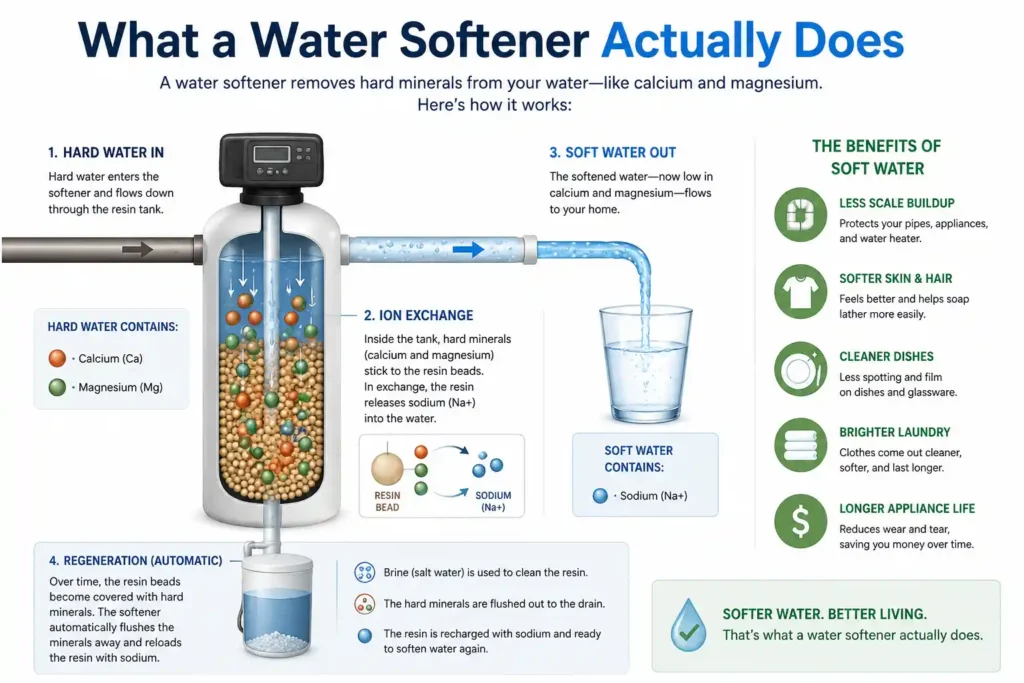
A water softener does not clean water like a filter does. It swaps hard minerals for softer ones. Most units use a process called ion exchange. Inside the tank sits a bed of tiny beads. These beads hold sodium. As hard water flows in, the beads grab calcium and magnesium. They let go of sodium in trade.
<<Get Amazon For This Product>>
That swap is the whole trick. Your water still has stuff in it. It just does not carry the calcium and magnesium that cause scale. It skips the soap scum too. It skips that dry, tight feel on your skin after a shower.
Here is a simple table I made after weeks of reading manuals. I also asked my plumber way too many questions.
| Feature | Water Softener | Water Filter |
| Main job | Removes hard minerals like calcium and magnesium | Removes bits, chemicals, or germs |
| Common method | Beads and salt trade minerals | Carbon block, sand layer, or a fine membrane |
| Fixes scale buildup | Yes | Rarely, unless paired with a softener |
| Removes chlorine taste | No | Often, if it uses carbon |
| Removes lead or germs | No | Depends on the filter type |
| Adds sodium to water | A small amount, yes | No |
Seeing it laid out this way is what made things click for me.
Does a Water Softener Filter Water? The Straight Answer
No. A water softener does not filter water. Not in the way most folks picture it. It does not strain out grit, chlorine, or germs. It does not make water safer to drink. A carbon filter does that job. A fine membrane system does that job too.
A softener treats one thing. That thing is hard. If your water report shows high calcium, a softener fits that job well. It will not catch rust flakes. It will not catch farm chemicals. It will not touch that chlorine smell from the tap.
I learned this the slow way. I thought my new softener would fix every water complaint I had. My glasses got fewer spots. That part was great. But the chlorine smell in the shower never left. That gap is the whole reason I sat down to write this.
What My Water Softener Removed and What It Missed
Within two weeks I saw real change. My soap lathered faster. The white film on my shower door began to fade. My coffee maker stopped clogging every month like it used to. Those wins felt bigger than I had hoped for.
But some things stayed the same. The faint chlorine smell stuck around on laundry day. My drinking water still had that flat taste. Some city water carries that taste from treatment. I filled a glass straight from the tap one night. I could taste the gap between that and water from a jug in my fridge.
That is when it hit me. Softening and filtering are two separate jobs. My softener was only built to do one of them.
The Day I Realized I Needed a Filter Too
Two months in, my daughter asked me a question. She wanted to know why fridge water tasted better than sink water. I did not have a good answer. So I looked into it that weekend. I added a simple carbon filter under the sink. Part of it was curiosity. Part of it was pure stubbornness.
The change was almost instant. The chlorine smell was gone within a day. The water tasted cleaner. It almost tasted sweet next to the old water. My daughter noticed before I even said a word. That told me it was not just in my head.
That weekend taught me something. I now tell every friend who asks about hard water. A softener and a filter are partners. They are not rivals. One handles minerals. The other handles taste, smell, and other stuff minerals do not explain.
Signs Your Home Might Need a Softener a Filter or Both
Here are the clues I now watch for. I learned some from my own home. I learned the rest from good research since then.
- Soap will not lather well and leaves a film on your skin
- White or chalky buildup shows up on faucets and shower heads
- Glasses and dishes come out of the dishwasher spotted
- Tap water has a chlorine or metal smell
- Drinking water tastes flat or slightly off
- Your water heater seems to work harder than it should
| Symptom | Likely Cause | Best Fix |
| Chalky buildup on fixtures | Hard minerals like calcium | Water softener |
| Chlorine smell in tap water | Chemical used to treat the supply | Carbon filter |
| Spotty dishes | Hard water minerals | Water softener |
| Flat or odd taste in drinking water | Chlorine or dissolved bits | Carbon filter or fine membrane system |
| Dry skin after a shower | Hard water minerals | Water softener |
If you spot signs from both columns, like I did, your home may need both tools working as a team.
What Install Day and the Cost Looked Like
The installation day was messier than I pictured. The tech showed up right after breakfast. He carried the tank through my garage and set it near the water line. It took about three hours from start to finish. There was some noise, some dust, and one small leak he fixed on the spot.
The unit itself cost close to twelve hundred dollars. Setup added a few hundred more. That number stung a bit at first. Then I did the math on soap, cleaners, and appliance repairs we had paid for before. The softener started to look like a smart trade, not just a cost.
By evening the water already felt different at the sink. It had a slicker feel between my fingers, almost like a light coat of lotion. That feeling took some getting used to. My wife hated it the first week. She loves it now.
My Honest Pros and Cons After a Year of Use
I want to be fair here. No tool is perfect. I do not want to oversell mine.
What I liked:
- My skin and hair felt softer within the first month
- Cleaning the bathroom took less work since scale stopped forming
- My kettle and coffee maker stopped clogging with white bits
- My clothes felt less stiff fresh out of the wash
What I did not love:
- The unit needs salt refills, and I sometimes forget
- It added a small amount of sodium to our water
- It did nothing for chlorine taste or smell, which caught me off guard
- The upfront cost was more than I first expected
None of these gaps made me regret buying them. They just taught me to set fair expectations first.
The Mistake That Taught Me the Most
Around month six, I got lazy. I skipped a salt refill for almost two months. I figured the softener would just keep running fine. It did not. Hard water crept back in slowly, so slowly I barely noticed at first.
Then my shower door fogged up with that old white film again. My coffee maker started to sputter. I felt a bit silly once I checked the tank and saw it was almost empty. That one slip taught me more than any manual ever did. A softener only works if you actually treat it like a tool that needs care, not a set it and forget it box.
Tips I Learned From Trial and Error
A few lessons took me longer than they should have.
- Check your salt level once a month, not once a year like I first did
- Clean the resin bed with a proper cleaner every few months
- Test your water hardness before and after setup so you can see real proof
- Pair your softener with a carbon filter if taste or smell bugs you
- Ask your installer about the sodium bump if anyone in your home tracks salt intake
Small habits like these saved me a service call and a lot of frustration.
FAQ
Does a water softener filter water?
Not really. A softener trades hard minerals for sodium through a bead system. It does not strain out chlorine, grit, or germs like a true filter does.
Can I drink softened water safely?
Most people can drink softened water with no issue at all. If you watch your salt intake, ask your doctor first, since softened water carries a small sodium bump.
Do I still need a filter if I already have a softener?
Many homes do well with both. The softener handles hardness. A filter handles taste, smell, and other stuff that minerals alone do not explain.
How often should I add salt to my water softener?
Check the tank once a month. Most homes refill every four to six weeks. Your own schedule may shift based on family size and use.
Will a water softener fix low water pressure?
Rarely on its own. Low pressure often comes from old pipes or a supply issue. Clearing years of scale can help a bit over time, though.
Final Thoughts
Looking back, that Saturday with the flecks in my kettle taught me a lot. A water softener solved a real problem in my home. I am glad I got one. It was just never built to filter water the way I first thought.
If your water feels hard, a softener is worth it. If your water also smells or tastes off, pair it with a good filter. That mix is what finally made our water feel right. It is the same advice I now give to anyone who asks me the question I once had.