

I had no idea how much water I was wasting. Every night after dinner, I stood at the sink, scrubbing plates, running hot water for what felt like forever. It felt clean. It felt thorough. It felt incredibly wasteful — but I did not know that yet.
Then one afternoon, I got curious. I read something that stopped me mid-scroll. It said a dishwasher uses far less water than hand washing. I did not believe it. So I dug in, ran some tests, and completely changed how I think about my kitchen routine.
Here is everything I found out about how much water a dishwasher uses — and why it surprised me more than I expected.
Table of Contents
What I Found When I Actually Measured My Water Use
I started paying attention to my water bill in January. My kitchen habits had not changed. I cooked almost every day. But I was still hand washing every single dish.
A friend of mine had a dishwasher and kept telling me it saves water. I brushed it off. How could a machine that fills up with water be more efficient than me being careful at the sink?
Turns out, I was very wrong.
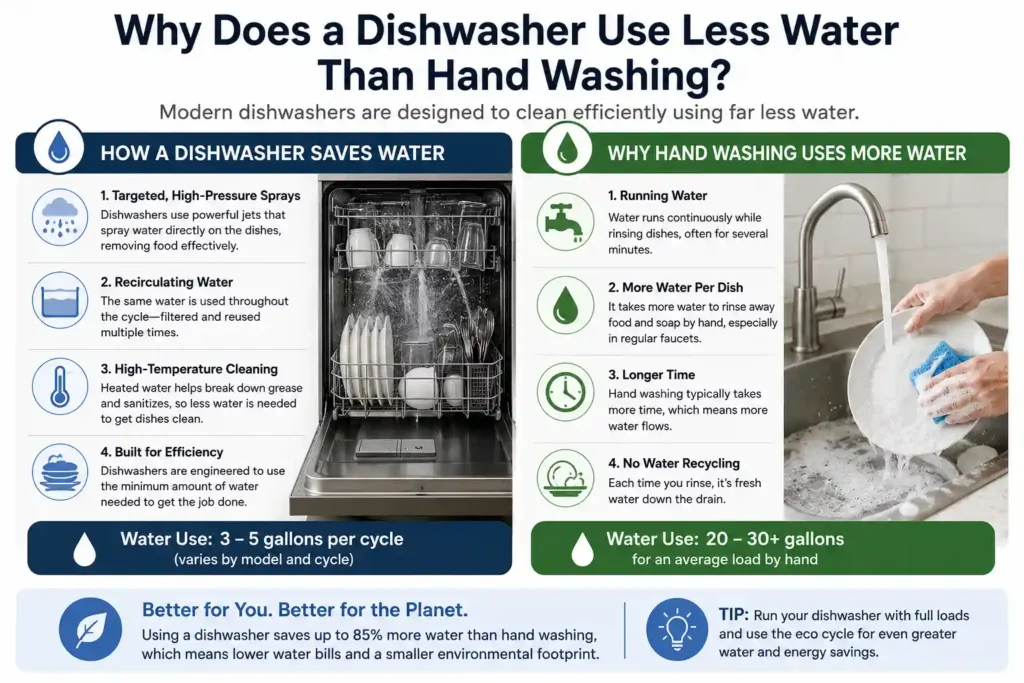
Hand washing a full load of dishes uses around 15 to 27 gallons of water. I checked this across multiple sources, and the numbers were consistent. Meanwhile, a modern dishwasher uses just 3 to 5 gallons per cycle. That gap is massive. I was using up to five times more water by hand.
That hit me hard. I thought I was being responsible. I was not.
How Much Water Does a Dishwasher Use Per Cycle?
This is the big question. And the answer depends on the type of dishwasher and the cycle you pick.
Here is a simple table to break it down:
| Dishwasher Type | Water Used Per Cycle |
| Older models (pre-2000) | 10 to 15 gallons |
| Standard modern models | 3 to 5 gallons |
| Energy Star certified | As low as 3 gallons |
| Portable/countertop models | 2 to 3 gallons |
When I looked at this table for the first time, I almost laughed. Older machines used almost as much water as hand washing. But modern ones? They cut that down dramatically.
My neighbor has an Energy Star dishwasher from 2022. She told me it uses about 3.2 gallons on a normal cycle. I used to use that much just rinsing one pot.
Does the Cycle Type Really Change Water Use?
Yes, it does. A lot, actually.
I tested this myself by paying close attention to the settings on a dishwasher I borrowed for a week. Here is what the different cycles looked like:
| Cycle Type | Approximate Water Use |
| Eco or energy-saving cycle | Around 3 gallons |
| Normal cycle | Around 4 to 5 gallons |
| Heavy-duty or pots cycle | Up to 6 to 7 gallons |
| Quick wash or express cycle | Around 4 gallons |
The eco cycle was the winner, hands down. It uses less water and less energy. The trade-off is time — it runs longer to heat water more slowly. But if you are not in a rush, it is the smart choice.
I also learned that the quick wash cycle is not always more efficient. It uses less time but sometimes more water to compensate for the shorter run. That surprised me.
Why Does a Dishwasher Use Less Water Than Hand Washing?
This is the part that really changed my thinking.
When I wash by hand, I let the tap run. A standard faucet flows at about 2 gallons per minute. If I spend 10 minutes washing dishes — and I usually do — I have used 20 gallons. Just like that.
A dishwasher is a closed system. It uses a small amount of water and recirculates it throughout the cycle. The water gets heated, sprayed, collected at the bottom, and sprayed again. Nothing is wasted the way it is at an open tap.
<<Get Amazon For This Product>>
The machine is also designed to clean efficiently. The spray arms hit every surface at high pressure. You get cleaner results with less water.
I still remember the smell of my first full dishwasher cycle — that warm, clean steam when you open the door. It felt almost magical compared to the lukewarm sink water I had been using.
What About Water Heating? Does That Count?
Good question. I asked myself this too.
Dishwashers heat their own water. Most models have an internal heater that brings water to around 120 to 140 degrees Fahrenheit. Some high-end models have a boost heater for the sanitize cycle, going even higher.
This heating uses electricity, not extra water. So the water savings are real. The energy use is a separate conversation — but even there, modern Energy Star dishwashers are designed to be efficient.
When I compared my old hand-washing routine — running hot water from the tap for 10 to 15 minutes — with a dishwasher cycle, the dishwasher still came out ahead on water. Every time.
The Load Size Question — Does It Matter?
This is where I made a mistake early on.
I thought running a half-empty dishwasher was still better than hand washing a few plates. Technically, the machine still uses the same amount of water either way. So a half-load is less efficient per dish.
The smart move is to wait until the dishwasher is full. Pack it well. Use every rack. That way, you spread that 3 to 5 gallons across 8 to 12 place settings. Your water cost per dish drops to almost nothing.
My rule now is simple. If it is not full, it does not run. I keep a small basin in the sink for anything that needs quick rinsing, and I let the rest wait for a full load.
Pre-Rinsing Is a Water Trap
I used to pre-rinse everything before loading the dishwasher. Every plate, every cup. It felt hygienic. It was also adding 6 to 10 gallons to every wash.
Modern dishwashers do not need pre-rinsing. They are built to handle food residue. Most manufacturers actually say that pre-rinsing is not necessary and can confuse the dishwasher’s soil sensors.
Yes, dishwashers have sensors. They detect how dirty the water is and adjust the cycle. If you pre-rinse everything clean, the sensor thinks the load is light and might use a shorter, less thorough cycle.
Just scrape off solid food and load it in. That is all.
Hard Water and Its Effect on Dishwasher Efficiency
I live in an area with moderately hard water. This matters more than I expected.
Hard water has high mineral content. Over time, those minerals build up inside the machine. They clog spray arms, coat the heating element, and make the dishwasher work harder. A machine working harder may use more water or deliver worse results.
The fix is simple. Use a rinse aid. Run a cleaning cycle with a dishwasher cleaner every month or so. If your water is very hard, a water softener can help.
I noticed my dishes were coming out spotty for a while. Once I started using rinse aid, that stopped. The machine also felt like it was running more smoothly.
Is a Dishwasher Worth It for Water Savings Alone?
Honestly, yes — if you use it right.
The water savings are real and significant. Going from 20 gallons of hand washing to 4 gallons per dishwasher cycle adds up fast. Over a year, a household that runs the dishwasher once a day saves tens of thousands of gallons compared to hand washing.
For me, the savings on my water bill were noticeable within two months. Not dramatic, but real. And knowing I was using less water felt good in a quiet, everyday kind of way.
But the key word is “correctly.” A half-empty dishwasher running every day with a heavy-duty cycle is not going to save much. A full dishwasher on an eco cycle, run only when full, makes a genuine difference.
My Final Takeaway on Dishwasher Water Use
So, how much water does a dishwasher use? Between 3 and 5 gallons per cycle for a modern machine. That is it.
Compare that to 15 to 27 gallons for hand washing, and the math is not even close. The dishwasher wins every time — as long as you use it smartly.
Load it full. Use the eco cycle when you can. Skip the pre-rinse. Maintain it well. Those four habits will get you the best water efficiency possible.
I wish someone had told me this earlier. I spent years feeling virtuous about hand washing when I was actually using far more water than I needed to. Now I know better — and so do you.
FAQ: How Much Water Does a Dishwasher Use?
Does a dishwasher really use less water than washing by hand?
Yes, and the gap is bigger than most people think. A modern dishwasher uses 3 to 5 gallons per cycle. Hand washing the same load can burn through 15 to 27 gallons. That is a difference worth paying attention to.
How much water does a dishwasher use on the eco cycle?
The eco cycle uses around 3 gallons per full load. It runs longer to heat water slowly, but it saves the most water of any setting. If you are not in a hurry, eco is the smart pick every time.
Does running a half-full dishwasher still save water?
Not really. The machine uses the same amount of water no matter how full it is. Wait until it is packed full before running it. That way, your 4 gallons of water cleans 10 to 12 place settings instead of just five.
Should I pre-rinse my dishes before loading the dishwasher?
No — and it actually wastes more water than you think. Pre-rinsing can add 6 to 10 gallons to every wash. Just scrape off solid food and load the dish in. Modern machines are built to handle the rest on their own.
Can hard water hurt my dishwasher’s water efficiency?
It can, over time. Hard water leaves mineral buildup on spray arms and the heating element, making the machine work harder. Use a rinse aid regularly and run a cleaning cycle once a month to keep things running at full efficiency.