
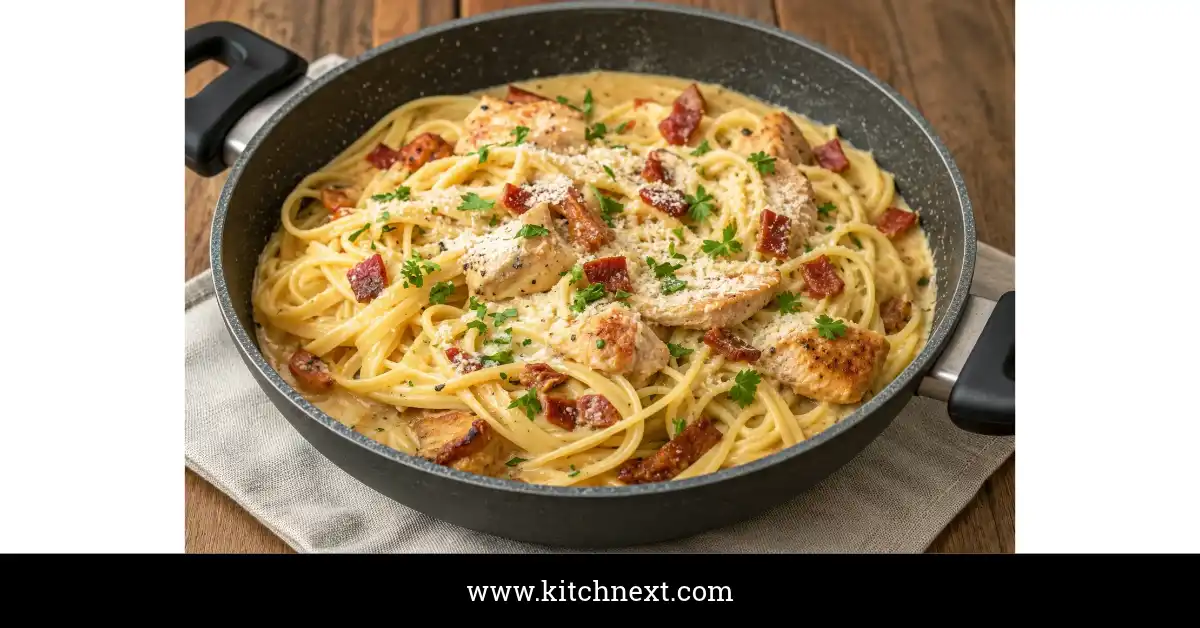
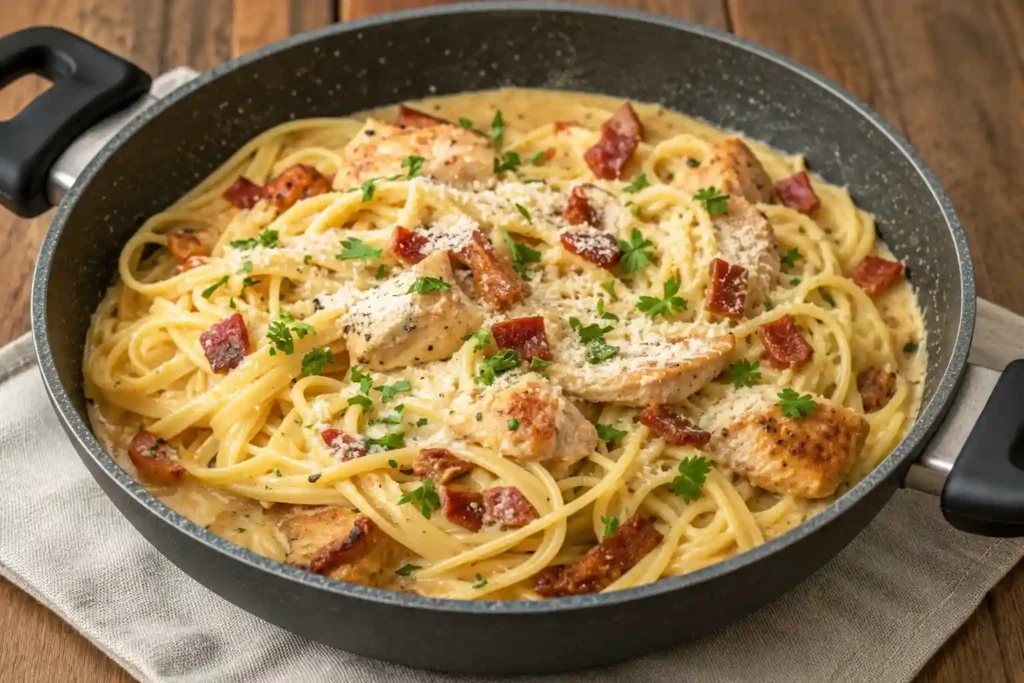
This Chicken Carbonara Recipe pairs golden pan-seared chicken breast and crispy pancetta with spaghetti in a traditional Roman-style egg and cheese sauce. Instead of heavy cream, you whisk whole eggs, Pecorino Romano, and Parmesan with starchy pasta water off the heat to create a glossy coating in 25 minutes.
The first time I cooked carbonara for a Friday date night at home, I left my skillet on a hot burner when I poured in the eggs. Within five seconds, the sauce hissed and curdled into dry yellow lumps of scrambled egg stuck to the noodles. I also cooked the chicken breast whole, which burned the outside before the thick middle cooked through.
After testing this Chicken Carbonara Recipe six times in my kitchen, I fixed both issues by slicing the chicken flat into thin cutlets and tossing the pasta completely off the heat. It is made for busy home cooks who want a rich, savory pasta dinner using simple supermarket ingredients.
Recipe Quick Facts
- Prep Time: 10 minutes
- Cook Time: 15 minutes
- Total Time: 25 minutes
- Servings: 4 servings
- Difficulty Level: Easy
Before You Get Started
- Set your eggs on the counter 20 minutes early. In my testing, cold eggs straight from the fridge drop the skillet temperature too fast and fail to thicken around the noodles. Room-temperature eggs blend smoothly with the warm cheese and pasta water.
- Grate both cheeses by hand on a fine rasp grater. Pre-shredded supermarket cheese contains potato starch to stop clumping in the bag. When I used pre-bagged Parmesan on my second test batch, it melted into gritty, stringy clumps instead of a smooth sauce.
- Butterfly the chicken breast into two even fillets. A thick whole chicken breast takes 14 minutes to cook and dries out around the edges. Slicing it horizontally gives you two flat cutlets that sear in 6 minutes and stay juicy.
- Salt your pasta water lightly. Pecorino Romano and cured pancetta already add plenty of salt to the dish. I use 1 tablespoon of kosher salt in 4 quarts of water so the final sauce tastes balanced rather than overly salty.
- Cook in a 12-inch stainless steel skillet. Nonstick pans struggle to brown the chicken properly, and heavy cast iron holds too much heat after you turn the burner off. Stainless steel builds golden brown drippings and cools down fast enough to protect the eggs.
Ingredients
- 1 large boneless, skinless chicken breast (250 grams / 9 ounces): Sliced horizontally through the middle into 2 equal thin fillets.
- 0.25 teaspoon fine sea salt: For seasoning the raw chicken fillets.
- 0.25 teaspoon freshly cracked black pepper: Plus 0.5 teaspoon extra for serving.
- 1 tablespoon extra-virgin olive oil: For searing the chicken in the skillet.
- 400 grams (14 ounces) dried spaghetti: Fettuccine, linguine, or pappardelle also work well.
- 3 large whole eggs: Brought to room temperature (68°F / 20°C).
- 50 grams (0.5 cup) freshly grated Pecorino Romano cheese: Finely grated for sharp, salty flavor.
- 25 grams (0.25 cup) freshly grated Parmesan cheese: Plus 2 tablespoons extra for topping the bowls.
- 2 tablespoons (28 grams) unsalted butter: Melted in the skillet to pick up the browned chicken drippings.
- 100 grams (3.5 ounces) diced pancetta: Cut into 0.25-inch cubes.
- 2 cloves garlic: Finely minced (2 teaspoons).
- 0.5 cup (120 milliliters) starchy pasta water: Scooped from the pasta pot right before transferring the noodles.
Instructions
Step 1: Prep and Sear the Chicken Breast
First, place the chicken breast flat on a cutting board and slice horizontally through the center with a sharp knife to make 2 thin fillets of equal size. Dust both sides with 0.25 teaspoon of fine sea salt and 0.25 teaspoon of black pepper. Next, heat 1 tablespoon of olive oil in a large frying pan over medium-high heat. Add the chicken fillets and cook for 6 minutes total, flipping once at the 3-minute mark, until golden brown and cooked to an internal temperature of 165°F (74°C). Transfer the chicken to a clean board to rest for 4 minutes, then slice into 0.5-inch strips. (I learned this the hard way after slicing my first batch straight out of the hot pan—all the juices ran onto the board and left the chicken dry.)
Step 2: Boil the Spaghetti
Meanwhile, bring 4 quarts of lightly salted water to a boil in a large pot. Add the 400 grams of spaghetti and stir right away so the strands do not stick. Bring the water back to a steady simmer and cook uncovered for 10 minutes until the pasta is tender with a slight bite in the center.
Step 3: Whisk the Egg and Cheese Base
While the spaghetti cooks, crack the 3 large eggs into a medium mixing bowl. Add the 50 grams of grated Pecorino Romano and 25 grams of grated Parmesan cheese. Beat the mixture with a fork or whisk for 45 seconds until the eggs and cheese form a thick, pale yellow paste, then set the bowl beside the stove.
Step 4: Crisp the Pancetta and Cook the Garlic
Next, place the unwashed frying pan used for the chicken over medium heat and add 2 tablespoons of unsalted butter. Once the butter melts and foams, add the 100 grams of diced pancetta and fry for 4 minutes, stirring often, until the fat renders and the edges turn crispy and deep golden brown. Turn the burner down to low heat, add the 2 cloves of minced garlic, and stir for 30 seconds until fragrant. (In my kitchen, I always lower the heat before adding garlic because hot pork fat burns minced garlic in 10 seconds and turns the sauce bitter.)
Step 5: Combine the Pasta, Chicken, and Sauce Off the Heat
Once the pasta finishes cooking, use tongs to transfer the wet spaghetti straight from the pot into the frying pan with the pancetta. Let the water clinging to the noodles drip into the pan, and scoop out 0.5 cup of pasta water from the pot as backup. Add the sliced chicken strips and toss over low heat for 1 minute. Next, turn off the burner completely and pour 0.25 cup of the reserved pasta water into the skillet. While holding the pan off the heat, slowly pour in the egg and cheese mixture while constantly lifting and lowering the spaghetti with tongs for 90 seconds. Add the remaining 0.25 cup of pasta water a splash at a time until a silky sauce coats every strand. (I found that constantly lifting the noodles with tongs releases steam and blends the starch, fat, and egg into a smooth glaze without scrambling.)
Step 6: Garnish and Serve
Finally, divide the coated spaghetti, chicken strips, and crispy pancetta evenly among 4 warm bowls. Sprinkle the top of each bowl with the extra 2 tablespoons of grated Parmesan cheese and 0.5 teaspoon of freshly cracked black pepper. Serve right away while hot.
How To Make
- Slice and season: Cut 1 large chicken breast horizontally into 2 thin fillets and season with 0.25 teaspoon each of salt and black pepper.
- Sear the chicken: Cook the fillets in 1 tablespoon olive oil over medium-high heat for 6 minutes (3 minutes per side), rest for 4 minutes, and slice into strips.
- Boil the pasta: Simmer 400 grams of spaghetti in salted boiling water for 10 minutes.
- Mix the sauce base: Whisk 3 large eggs with 50 grams grated Pecorino and 25 grams grated Parmesan in a bowl.
- Fry pancetta and garlic: Melt 2 tablespoons of unsalted butter in the chicken skillet over medium heat, fry 100 grams diced pancetta for 4 minutes until crisp, then cook 2 minced garlic cloves on low for 30 seconds.
- Toss and emulsify: Transfer wet spaghetti and chicken strips into the pan with tongs, toss for 1 minute, turn off the heat, add a splash of pasta water, and pour in the egg mixture while lifting the pasta non-stop for 90 seconds.
- Plate and garnish: Divide into 4 bowls and top with extra grated Parmesan and black pepper.
Tips for Best Results
- Listen for the sizzle when adding pasta water. When you turn off the heat and splash pasta water into the pan, you should hear a brief 2-second sizzle. In my testing, if the pan roars loudly when the water hits, the metal is still hotter than 160°F (71°C) and needs 30 seconds to cool before you add the eggs.
- Watch for mahogany edges on the pancetta. Do not rush the 4-minute rendering step. If the pancetta looks pale pink and chewy, it has not released enough liquid fat into the butter to emulsify the cheese and pasta water.
- Save the cutting board juices. When the seared chicken rests on the board, a tablespoon of savory juice pools underneath. Pour that liquid straight into the skillet with the chicken strips for extra flavor in this Chicken Carbonara Recipe.
- Use tongs instead of a wooden spoon to mix the sauce. Flat wooden spoons mash the spaghetti down against the hot bottom of the skillet. Tongs let you lift the noodles up into the air so the eggs coat the pasta evenly without overheating.
Comparison/Tips Table
If you need to swap an ingredient in this Chicken Carbonara Recipe, use the table below based on my kitchen tests:
| Original Ingredient | Best Substitute | Effect on Taste and Texture |
| Diced Pancetta (100 g) | Guanciale (100 g) or Thick-Cut Unsmoked Bacon (100 g) | Guanciale is the traditional Roman cut and renders richer pork fat; bacon adds a smoky flavor that slightly changes the classic profile. |
| Spaghetti (400 g) | Fettuccine, Linguine, or Pappardelle (400 g) | Wider flat ribbons hold more of the thick egg-and-cheese glaze per bite while keeping the exact same 10-minute cook time. |
| Pecorino Romano (50 g) | 100% Parmigiano-Reggiano (75 g total) | Produces a milder, nuttier, and slightly sweeter sauce; add an extra pinch of black pepper to make up for Pecorino’s sharpness. |
| Chicken Breast (250 g) | Boneless, Skinless Chicken Thighs (250 g) | Thighs take 8 minutes to sear instead of 6 minutes and give the dish a richer, dark-meat flavor. |
| Unsalted Butter (2 tbsp) | Extra-Virgin Olive Oil (1.5 tbsp) | Creates a lighter, dairy-free cooking fat base for the pancetta, though the finished sauce tastes slightly less buttery. |
Storage & Reheating
- Refrigerator Storage: Store cooled leftovers from this Chicken Carbonara Recipe in an airtight glass container in the refrigerator for up to 3 days. Do not freeze this dish, as freezing breaks the egg emulsion and turns the sauce grainy upon thawing.
- Stovetop Reheating: Place the chilled pasta and chicken in a skillet over low heat with 2 tablespoons of water or chicken broth per serving. Toss gently with tongs for 3 minutes until warmed to 165°F (74°C). Avoid the microwave, which scrambles the egg coating and makes the chicken rubbery.
- Estimated Nutrition: Each serving (1 of 4) contains an estimated 685 calories, 41 grams of protein, 74 grams of carbohydrates, and 24 grams of fat. Disclaimer: All nutritional numbers are estimated values; please calculate exact figures using a nutrition calculator based on the specific brands and measurements you use in your kitchen.
FAQs
Why did my chicken carbonara sauce scramble instead of turning creamy?
Carbonara sauce scrambles when the skillet is hotter than 160°F (71°C) when the eggs go in. Always turn the burner completely off, add a splash of starchy pasta water to cool the pan surface, and lift the spaghetti continuously with tongs while pouring in the egg mixture.
Can I make chicken carbonara without heavy cream?
Yes, authentic carbonara never uses heavy cream. The creamy texture comes from emulsifying whole eggs, finely grated Pecorino Romano and Parmesan cheeses, rendered pancetta fat, and starchy pasta cooking water off the heat until a glossy sauce coats the noodles.
What is the best substitute for pancetta in chicken carbonara?
Guanciale (Italian cured pork jowl) is the traditional upgrade and provides rich pork fat. If you cannot find pancetta or guanciale at your grocery store, use 100 grams of diced thick-cut unsmoked bacon, or turkey bacon with 1 extra tablespoon of butter.
How do I keep chicken breast from drying out in pasta?
Slice one large chicken breast horizontally through the middle to create two thin, even fillets before cooking. Sear the thin fillets over medium-high heat for just 6 minutes total, then let the meat rest on a cutting board for 4 minutes before slicing into strips.
Why do I need to save pasta water for carbonara?
As spaghetti boils, it releases starch molecules into the water. When you toss that cloudy, starchy water with rendered pancetta fat, butter, and egg-cheese paste, the starch binds the liquid and fat together so the sauce clings smoothly to the pasta without separating.