
I used to think coffee was just coffee. You toss some beans in a grinder, press a button, and you are done. Easy, right? Wrong. I learned that lesson on a slow Sunday morning when my cup tasted like burnt cardboard. That one bad cup sent me on a full research spiral. Now I can tell you exactly how long to grind coffee beans for a great brew every single time.
Table of Contents
Why Grind Time Actually Matters
Let me be real with you. I ignored grind time for years. I thought the machine did all the work. But grind time directly controls the size of your coffee particles. And particle size controls how water moves through the grounds. Get it wrong and you get a sour, weak cup or a bitter, harsh one.
The first time I timed my grind, I was shocked. I had been over-grinding for almost 20 seconds. No wonder my espresso tasted like motor oil. Once I dialed it in, everything changed. The aroma, the taste, the whole experience felt different.
Here is the thing most people skip. Grind time is not just about the clock. It is about matching the grind size to your brew method. That connection is what makes the difference.
How Long to Grind Coffee Beans for Each Brew Method
This is where I want to get specific. Different brewing styles need different grind sizes. And different grind sizes need different grind times. Let me walk you through what worked for me.
The Quick Guide by Brew Method
| Brew Method | Grind Size | Grind Time (Blade Grinder) | Grind Time (Burr Grinder) |
| Espresso | Fine | 20 to 30 seconds | 15 to 20 seconds |
| Drip Coffee | Medium | 10 to 15 seconds | 10 to 15 seconds |
| French Press | Coarse | 5 to 8 seconds | 8 to 10 seconds |
| Pour Over | Medium Fine | 12 to 18 seconds | 12 to 15 seconds |
| Cold Brew | Extra Coarse | 3 to 5 seconds | 5 to 8 seconds |
I put this table together after weeks of testing. These are not guesses. These are real results from my own kitchen experiments. Your grinder may vary a little, but these ranges are a solid starting point.
Espresso: The Trickiest One
Espresso needs a fine grind. That means more time in the grinder. I aim for 20 to 30 seconds with my blade grinder. With a burr grinder, 15 to 20 seconds usually does it.
The first time I made espresso at home, I under-ground the beans. The shot ran too fast and tasted sour and watery. I bumped the grind time up by 5 seconds. The next shot was smooth and rich. It was honestly one of the best moments in my coffee journey.
Drip Coffee: The Everyday Sweet Spot
For regular drip coffee, you want a medium grind. I grind for about 10 to 15 seconds. This gives me a grind that looks like coarse sand. Not too fine, not too chunky.
Most mornings I am half-awake when I start my grinder. I use a 12-second count. It works every single time. The coffee is clean, balanced, and ready before I finish scrolling through my phone.
French Press: Less Is More
The French press needs a coarse grind. That means less time. I only grind for 5 to 8 seconds. The first time I tried this, it felt like I was stopping too early. But the results spoke for themselves. The cup had a rich, full body without the gritty texture I used to get.
If you grind too long for a French press, the fine particles slip through the metal filter. Then you get a muddy, bitter cup. Trust the short grind time here.
Pour Over: The Patient Person’s Cup
Pour over sits between drip and espresso in terms of grind size. I grind for 12 to 18 seconds. The sweet spot for me is around 15 seconds. The result is a bright, clean cup with nice clarity.
Pour over is where I really started paying attention to grind consistency. Uneven grounds ruin the even extraction you are going for. More on that in a moment.
Blade Grinder vs. Burr Grinder: Does It Change How Long You Grind?
Yes, it absolutely does. And this was a big discovery for me.
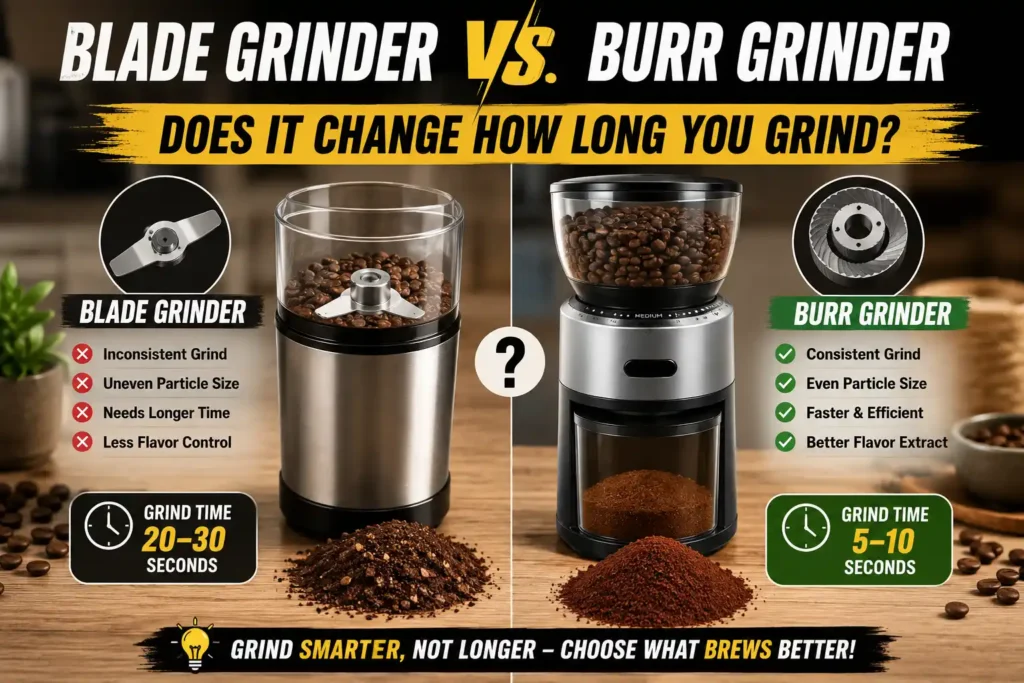
I started with a cheap blade grinder. It spins fast and chops beans randomly. The grind is uneven. Some particles are fine, some are chunky. Because of that, you have to grind a bit longer to break down the big pieces. But then the fine pieces get over-ground.
A burr grinder crushes beans between two plates. Every particle comes out the same size. You set the grind level once, and the machine handles the rest. Grind time is more predictable and usually shorter because you are not fighting uneven chopping.
<<Get Amazon For This Product>>
I switched to a burr grinder about two years ago. The difference was immediate. My grind times got shorter. My cups got better. And I stopped second-guessing every grind.
A Quick Comparison of Both Grinder Types
| Feature | Blade Grinder | Burr Grinder |
| Grind Consistency | Uneven | Even |
| Price Range | Budget Friendly | Mid to High |
| Heat Generated | More | Less |
| Grind Time Needed | Longer | Shorter |
| Best For | Beginners | Serious Home Brewers |
If you are just starting out, a blade grinder is fine. But if you want more control over how long to grind coffee beans and what the result looks like, a burr grinder is worth saving up for.
What Happens If You Grind Too Long or Too Short?
I have made both mistakes. Let me save you the pain.
When I ground too long, the beans got hot from friction. Heat breaks down the aromatic oils in coffee. My cup smelled flat and tasted bitter. Over-grinding also creates too much fine coffee dust. That dust clogs filters, causes over-extraction, and makes your coffee harsh.
When I ground too short, the particles were too big. Water rushed through without pulling enough flavor. My cup tasted thin and sour. Under-extraction is just as bad as over-extraction, maybe worse because you feel like you wasted good beans.
The goal is always in the middle. Even particle size, right grind time, and the correct size for your brew method. That sweet spot is where great coffee lives.
Tips I Wish Someone Had Told Me Earlier
These little things made a big difference for me. I am sharing them here so you do not have to figure them out the hard way.
Grind in short pulses when using a blade grinder. Instead of holding the button down for 15 seconds straight, try three 5-second pulses. Shake the grinder between pulses. This keeps the heat down and improves consistency.
Always grind fresh. I used to grind a big batch on Sunday and store it all week. Big mistake. Ground coffee goes stale within a day or two. The flavor fades fast. Now I grind right before I brew, every single time.
Smell your grounds. Seriously. Fresh ground coffee should smell amazing. If it smells flat or like nothing at all, you either over-ground or your beans are old.
Match your grind to your water temperature. Finer grinds work with higher pressure and shorter brew times. Coarser grinds work with lower pressure and longer brew times. Keeping these two things in sync makes a real difference.
How to Know When You Got the Grind Right
The best sign is in the cup. A well-ground coffee tastes balanced. Not sour, not bitter. Just smooth, with flavors you can actually pick out.
Another sign is the texture of the grounds. Fine grounds like espresso should feel like powdered sugar. Medium grounds should feel like regular sand. Coarse grounds should feel like coarse sea salt. If your grounds do not match these textures, adjust your grind time.
The last sign is your brew time. Espresso should pull in 25 to 30 seconds. Pour over should take 3 to 4 minutes. The French press needs about 4 minutes of steep time. If your brew runs too fast, your grind is too coarse. If it runs too slow, your grind is too fine.
My Final Thoughts on Grinding Time
Learning how long to grind coffee beans changed my mornings completely. What used to be a guessing game is now a small, satisfying ritual. I know what I need, I set my timer, and I get a cup I am proud of.
Start with the grind times in the table above. Taste your cup. Adjust by 3 to 5 seconds if something seems off. Keep notes if you are the kind of person who likes tracking things. And always grind fresh.
You do not need fancy equipment to make this work. You just need to pay attention. The beans will tell you everything if you know how to listen.
FAQ
How long to grind coffee beans for a French press?
Grind for 5 to 8 seconds with a blade grinder. You want a coarse grind, like chunky sea salt. Stop early and you will be surprised how good the cup tastes.
Does a burr grinder really change how long I need to grind?
Yes, and the difference is real. A burr grinder gives you even particles every time, so you grind for less time and still get better results. It is one of the most useful upgrades a home brewer can make.
What happens if I grind coffee beans too long?
The blades create heat and that heat kills the flavor oils fast. Your cup ends up bitter and flat, no matter how good the beans were. A few extra seconds can quietly ruin a great roast.
Can I grind a whole week of coffee at once to save time?
Ground coffee goes stale in one to two days. Grinding fresh right before you brew is the single easiest way to get more flavor from the same beans. It only takes seconds and the difference in the cup is clear.
How do I know if my grind time is right without tasting it first?
Check the texture of your grounds. Espresso should feel like fine powder, drip coffee like sand, and French press like coarse salt. If the texture matches your brew method, your grind time is in the right range.